

Calling all Chileheads
Shatta is a spicy condiment that deserves a place on your table.

Hey, you, Chileheads, Pepperheads and Hot-Sauce-Bosses, c’mon over. We have a chile pepper sauce that you must add to your repertoire. It’s the Palestinian spicy condiment called shatta.
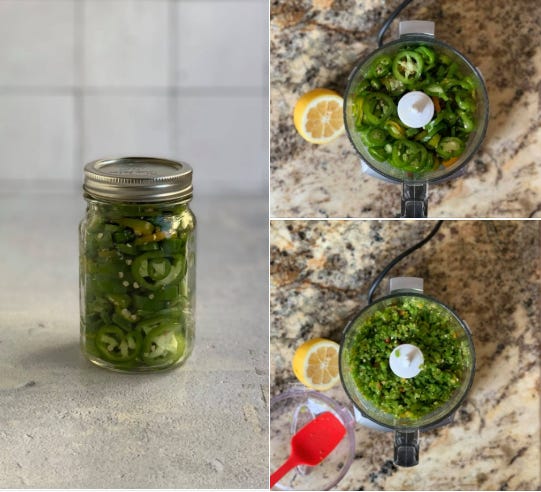
Meet Shatta: A fiery fermented chile pepper sauce with a bit of tang. It can be made with any hot pepper. After fermenting the sliced chiles and their seeds with salt for three days, you blitz it in the food processor and add vinegar and lemon juice (and sometimes garlic). If you look at the ingredient list of a bottle of Tabasco, you’ll see pretty much the same ingredients. It’s popularly used in the Middle East to cut the richness of dishes or to perk up flavors.


“This fiery condiment is as easy to make as it is easy to become addicted to,” write Chef Sami Tamimi and Tara Wigley in Falastin: A Cookbook. And it’s true. Shatta’s been a staple in our refrigerators since we discovered it in 2020 in Falastin.
The beauty of making shatta is that you can turn the heat up or down by the peppers you choose and how many seeds you include. We’ve made it with green jalapeño and serrano peppers and with red Fresno peppers. We’ve also used a combo of green and red. Fresno peppers are Sarene’s go-to because they’re a little hotter and sweeter.
We use shatta as a salsa substitute on dishes like quesadillas, tamales and in refried beans. It’s great on all kinds of breakfast eggs and as a way to perk up any dish that’s a little bland.
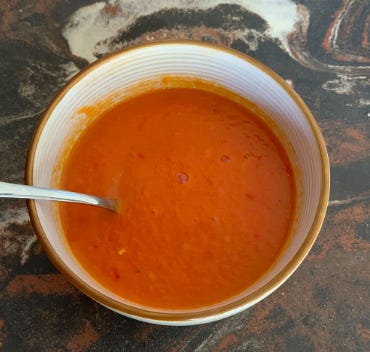
Deep Dive: “Shatta” translates to "hot pepper" in Arabic.
Shatta
Adapted from Falastin: A Cookbook by Sami Tamimi and Tara Wigley.
Makes 1 jar
9 ounces red or green chiles with seeds (we like red or green jalapeños, Fresno, and serrano peppers), stems trimmed, thinly sliced (they don’t have to be perfectly even)
1 tablespoon salt
3 tablespoons cider vinegar
1 tablespoon lemon juice
Extra virgin olive oil, to cover
Add the chiles and salt to a medium-size sterilized* jar. Put on the lid and shake well to distribute the salt throughout the chiles. Refrigerate for 3 days.
Drain the chiles, reserving the liquid. Put the chiles in a food processor, and blitz until you have a coarse paste—you want some texture.
Add the vinegar and lemon juice, and pulse to combine. You can add some of the reserved liquid to adjust the texture of the sauce. (Keep the rest of the liquid to use as you would a hot sauce.)
Put the mixture in the same jar you used for fermenting. Pour olive oil over the mixture to cover it. You can keep in the fridge for up to 6 months. (Note: When refrigerated, the olive oil will solidify. Simply stir the oil into the chiles.)
*Run the jar through the dishwasher to sterilize it.
What’s adding ☀️sunshine☀️ to our plates:
Watching Sarene make shatta 😊 :
Celebrate National Hot Sauce Day. (It was Jan. 22, so we’re not too tardy.)
Want more fiery flavors? Check out Fiery Ferments: 70 Stimulating Recipes for Hot Sauces, Spicy Chutneys, Kimchis, and Condiments, by Kirsten K. Shockey and Christopher Shockey.
Enjoy!
Beth and Sarene (more about us in the welcome post)
P.S. If you enjoyed this post, please consider tapping the ❤️, restacking it and/or leaving a comment. It doesn’t take long, and it’s so helpful to our community!
Yesss! I love that you’re sharing a post about shatta. A few months ago, I posted a note about a homemade shatta that I made and was enjoying with Thanksgiving leftovers. It brought a fresh, bright, and spicy angle to all the rich Thanksgiving food. I also learned about it from Falastin, what a fantastic cookbook :)
Would love myself some shatta, considering I’m a bonafide chilehead. I come from the western part of India where we have a condiment called thecha. It is made by pounding green chile peppers either with garlic or without. It is essentially farmer food paired with a millet bread. But it is made fresh for immediate consumption or for a couple of days at the most.